
October 20, 2026
Grain Overview
The overnight grain trade turned firmer as French milling wheat returned sharply higher overnight, gaining €4.00/MT again, throwing support to our wheat market, which has gone to a discount, and Euronext corn gained €2.00/MT to 294.75, heading back higher again after both went through a two-day correction from last week’s strong gains. Within weeks, we should start seeing improving flash corn sales to European buyers. Also, a sharply higher crude oil market this morning, with the active December contract trading above $100.00, is raising eyebrows, along with the reality that biofuel needs will remain strong with profits high.
President Trump announced $8 billion in emergency diesel fuel relief for US farmers to help offset higher fuel costs during the 2026 harvest. The proposed program would provide one-time payments to eligible producers based on a portion of their estimated losses. Producers are encouraged to create a Login.gov account in advance of the application period announcement. Pre-filled applications will be available online to producers with a Login.gov account linked to USDA. Crop insurance linkage will not be required for participation in the Harvest Fuel Relief program.
We are just over the halfway mark for estimating Crop Insurance Harvest Average prices, and corn is at $4.89 compared to the spring price of $4.62, while soybeans are at $12.81 compared to $11.09. The next crop report is November 10. Harvest will be mostly behind us, and the USDA should have plenty of “real” data to sort through.
No killing frost is forecast through October 29 throughout the Central US, but near-complete dryness should be in place at least until the opening days of November. Rain chances do develop in Nebraska, then northeasterly into Minnesota, next Tuesday/Wednesday, but they are just considered light rain showers. Meanwhile, in South America, Mato Grosso and Goias are trending drier as projected rain for the northern half of this soybean belt in Brazil is turning drier for the last half of October. Concern will start to grow as November rainfall will be monitored for shortfalls, which El Niños are known for.
Crop progress reports have corn behind a bit more than expected in yesterday’s data, but it’s likely, with this week being open, that bean harvest could be wrapping up by the end of the month and corn after the first full week of November. November 10 brings the next crop production/WASDE report, and with more plot information and farmer survey-reported yield data, trade thoughts are circling around a softer corn yield while soybeans may be raised.
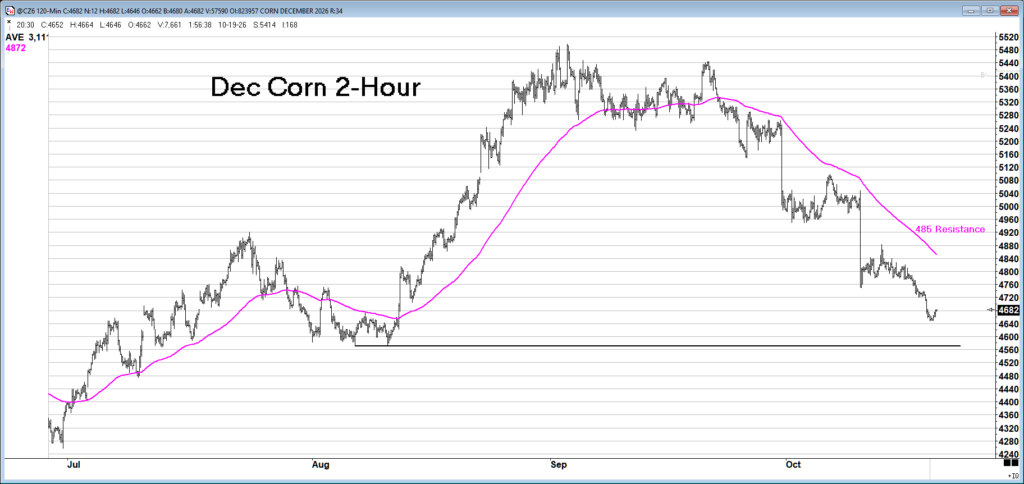
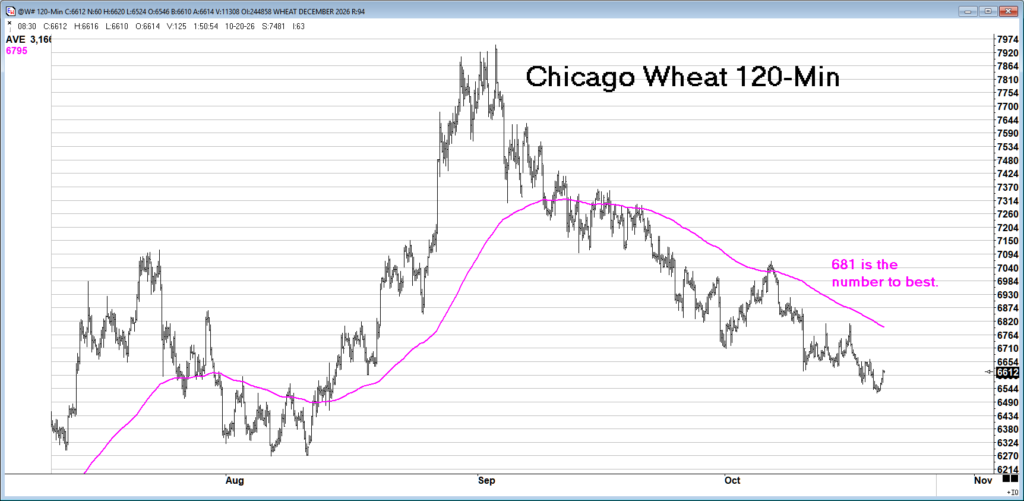
All grain contracts are now approaching some major values since the September 1 highs, with corn near the August low of 457-460, soybeans approaching major value at the quadruple top breakout at 1240, and Chicago wheat at 650. A lot of work needs to be done to reveal a low is in place, and it will be difficult with harvest pressure through this week. Currently, numbers to overcome the bearish trend on the intraday charts shown below are 485 on December corn and 681 for December wheat.
Cattle Overview
Yesterday’s cattle trade had live cattle consolidating another week of strong gains, while feeder cattle went to a premium over the cash index, and deferreds continued to show price improvement. Continued price declines in corn continue to improve optimism for feeder cattle after corn made a high on September 2, following feeder cattle being at their worst price of the year on August 26.
The feeder cattle market is also building in premiums for this Friday’s Cattle on Feed report, where placements are again expected to be below last year in the 92-93% range. If a print is much higher than that, it’ll take the air out of the recent price lift.
Packers picked up 90,762 head last week, an increase of 23,061 head over the prior week. This gives them inventory again to wait out the week and see what this COF report says. Boxed beef values yesterday had choice off slightly, but select jumped $6.86.
Columbus, New Mexico, is anticipated to start receiving Mexican feeder cattle by early next week. The demand for calves remains high, given consumer beef consumption remains strong and has absorbed the extra beef trimming imports. Feeder cattle, though, have recovered into resistance zones that will start to slow upside price movement.
December cattle have elevated themselves to near 228, and yesterday showed some vulnerability, but that could also mean more early-week price stalling, similar to last week. Major support is in play at 224.75-225.00 if corrective action on the board gets wild again.
November feeder cattle yesterday achieved 344, but did so on a very strong performing day. January feeders have now taken over spot designation this week on the continuation charts and may also be targeting recent resistance at 342. Large daily ranges bring in intraday support on the hourly chart at 336, with major trending support now at 331. March feeder cattle have recovered into a major opportunity range for hedging. Granted, it is large at 332-342, but then, after all, they are a volatile market. The recovery has occurred from the price low of 293.50.
Since the announcement of the US/Mexican border opening to feeder cattle, I’ve been consistently saying that we will never see a full reestablishment of calves in the United States at 100,000 head per month. The likely number will be closer to 85,000 head, as the Mexican cartels have learned they can make some good money feeding calves, processing them on their side of the border, and shipping it tariff-free into the US as boxed beef.
Any Questions and to inquire about Livestock Risk Protection Insurance Call: 701-222-0221
Past performance is not indicative of future results. The information contained in this report is intended for informational purposes only and is the opinion of the writer and may change at any time. This information was compiled from sources believed to be reliable to Heartland Investor Capital Management, Inc. but accuracy cannot be and is not guaranteed. There is no warranty, expressed or implied, in regards to this information for any particular purpose. There is SIGNIFICANT RISK of LOSS involved in trading futures and / or options on futures and may not be suitable for all investors. Investors should consider these RISKS and evaluate their suitability based on their financial conditions. No one should ever consider trading futures or options on futures with anything other than RISK CAPITAL. NO LIABILITY on the part of the author exists for any trading loss you may incur in the use of this information. The information contained in this newsletter is privileged, confidential and protected from disclosure. Any further disclosure or use, distribution, dissemination or copying of this message or any attachment is strictly prohibited. Provided by Heartland Investor Capital Management, Inc. a registered CTA with the NFA, of which Eugene Graner is principal. This entity is a separate legal entity from the Introducing Broker Heartland Investor Services.